

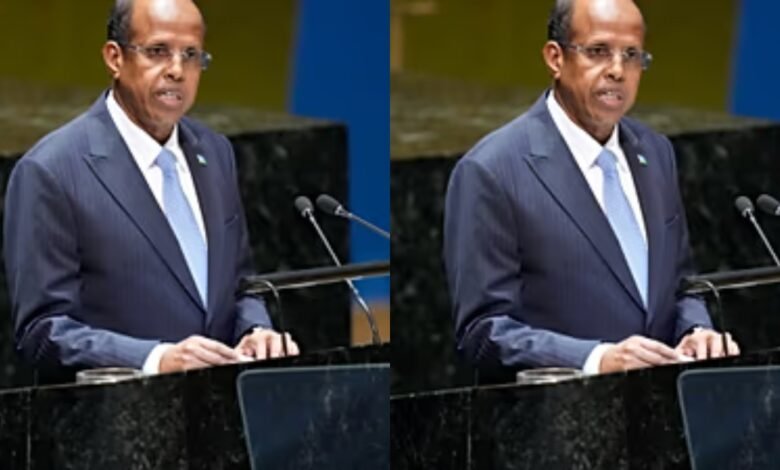
The Chairperson of the African Union Commission, Mahmoud Ali Youssouf, has issued a firm rebuttal to U.S. President Donald Trump’s claims that a genocide against Christians is occurring in northern Nigeria.
Speaking at the United Nations in New York on Wednesday, December 17, 2025, Youssouf warned the U.S. administration to “think twice” before making such inflammatory statements. He argued that the violence in Nigeria, primarily driven by the extremist group Boko Haram, does not mirror the ethnic cleansing or systemic atrocities seen in regions like Sudan or the eastern Democratic Republic of Congo (DRC).
Central to the AU’s rejection of Trump’s narrative is the demographic data regarding the victims of the 15-year insurgency. While the U.S. President suggested that “very large numbers” of Christians are being targeted, humanitarian and military data consistently show a different reality.
Human rights experts and local researchers emphasize that because the insurgency is concentrated in the Muslim-majority northeast, the vast majority of those killed, displaced, or abducted by Boko Haram are Muslims.
While Christians have certainly been targeted in high-profile kidnappings and church attacks, the AU maintains that these are part of a broader, non-sectarian terror campaign rather than a targeted genocide against a specific religious group.
The diplomatic tension follows Trump’s recent threats to bypass diplomatic channels and engage in “fast” military action against Nigeria. Trump stated he would consider going into Nigeria “guns-a-blazing” to “wipe out Islamic Terrorists” if the Nigerian government failed to protect its Christian population.
The U.S. President also threatened to cut off all U.S. aid and assistance to Nigeria, which he characterized as a “disgraced country.”
However, the Nigerian Foreign Ministry has sought to de-escalate the rhetoric, reiterating its commitment to defending all citizens “irrespective of race, creed, or religion” and expressing hope that Washington remains a strategic ally in the fight against extremism.