

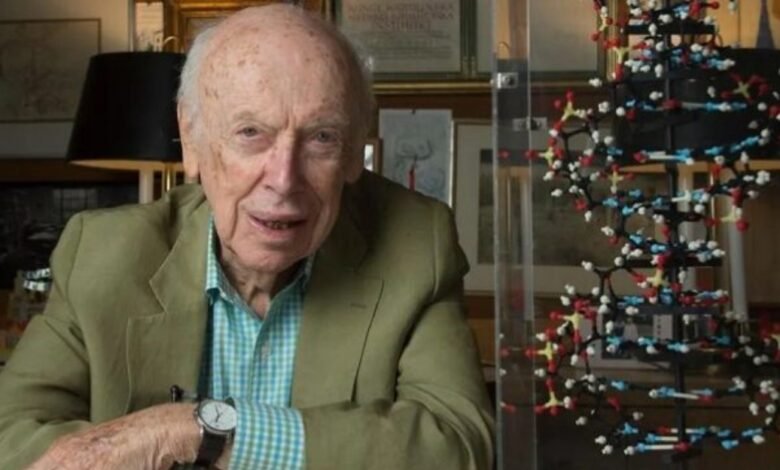
James Watson, the American molecular biologist who famously co-discovered the double-helix structure of DNA, has passed away at the age of 97. His death was confirmed by the Cold Spring Harbor Laboratory, an institution he transformed into a world-class research hub over several decades before his eventual professional fallout.
While his 1953 breakthrough alongside Francis Crick and Maurice Wilkins provided the fundamental “secret of life” and earned him a Nobel Prize in 1962, his monumental scientific legacy remained deeply entangled with his history of making inflammatory and scientifically unsupported remarks regarding race, gender, and intelligence.
In his later years, Watson became a polarizing figure, largely ostracized by the global scientific community for asserting that genetic factors caused differences in average IQ between racial groups.
These comments first led to his resignation as chancellor of Cold Spring Harbor in 2007 and culminated in 2019 when the laboratory stripped him of his remaining honorary titles after he doubled down on his views in a television documentary.
Despite his initial apologies, the scientific establishment repeatedly condemned his statements as reprehensible and contrary to modern genomic research, which emphasizes that environmental and socioeconomic factors, rather than race, drive variations in testing scores.
Beyond the racial controversies, Watson’s career was also defined by the complicated history of the DNA discovery itself, specifically the uncredited use of X-ray images captured by researcher Rosalind Franklin. While Watson was credited with nurturing some female scientists’ careers, he was frequently criticized for the sexist remarks he wrote about Franklin in his best-selling book, The Double Helix.
In a final act of public defiance against his professional isolation, he became the first living Nobel laureate to sell his gold medal at auction in 2014, though it was eventually returned to him by the purchaser. He is survived by his wife and two sons, one of whom inspired Watson’s later research into the genetic underpinnings of mental illness.